.png)

Think about your tech stack for a second.
Where do people find you? Where do they opt in? Where do they buy? Where do you host your course content?
If your honest answer is "a few different places," you're not unusual. Most online businesses are running on multiple tools at once: a landing page platform here, a checkout tool there, maybe a community or course platform on top of it all.
Here's the problem: most affiliate programs aren't built that way.
The most common way people do affiliate tracking is baked into one specific platform. Which means it can only see activity that happens inside that platform. If one of your affiliates drives a lead who clicks a link, opts in on your landing page, and then buys through a different checkout page, some or all of that journey gets lost.
That means your affiliate program is flying partially blind.
Cross-platform affiliate tracking fixes this. And if you're running any kind of multi-tool business, it's not a nice-to-have. It's the foundation everything else is built on.
If you're a course creator or digital product seller, you probably didn't sit down one day and plan out your tech stack. It grew naturally. You found a course platform you loved, then discovered a checkout tool with better features, then added a landing page builder for launches, then joined a community platform to host your members…
That's not a sign of disorganization. That's just how online businesses get built. You pick the best tool for each job.
The result is something like this: your courses live on Kajabi. Your checkout runs through ThriveCart or SamCart. Your launch landing pages are on WordPress or Leadpages. Your community might be on Circle or Mighty Networks. Each tool does its job well, and together, they make your business run.
The problem shows up when you layer an affiliate program on top of all of it.
It’s likely that one or more of the programs in your tech stack offers a built-in affiliate program, and so it might seem like that’s the most logical thing to use.
But if your affiliate tracking only lives inside one of those tools, it can only see what happens inside that tool. The rest of your customer journey, the opt-ins, the lead captures, the cross-platform paths people actually take before they buy, goes untracked.
And for a lot of course creators and digital product sellers, that's exactly the situation they're in without realizing it. Their affiliate program is technically running. It's just not seeing the whole picture.
One more thing worth naming: the built-in affiliate tool that comes with your platform probably feels free. And in the sense that it's included in your subscription, it is. But "free" assumes it's actually doing the job. When attribution is missing, leads go untracked, and affiliates quietly disengage, the real cost shows up in revenue you didn't earn and partnerships you didn't keep. A dedicated affiliate tracking tool is an additional line item, but it's one that pays for itself when your program is actually working the way it should and it drives more affiliate sales from happier affiliates.
When your affiliate tracking is tied to a single platform, the gaps aren't always obvious at first. Early on, when your program is small and your tech stack is simple, it might seem to work fine.
But as your business grows to include more affiliates, more platforms, more touchpoints in the customer journey, those gaps start to matter.
Here's what actually gets lost.
The good news is that none of this is permanent. It's a systems problem, and systems problems have solutions.
Cross-platform affiliate tracking does one thing really well: it follows the affiliate link, not the platform.
That means it doesn't matter where someone opts in, where they buy, or how many tools are in between. When a person clicks an affiliate link, that attribution travels with them through your entire funnel, across every platform, every touchpoint, every step of the journey. If they convert three days later on a completely different page, the affiliate still gets credit.
For course creators and digital product sellers running multi-tool businesses, this changes everything about how your affiliate program functions.
A few specific things it makes possible:
Tracking across your whole stack simultaneously. You don't have to choose which platform your affiliate program "lives in." It lives across all of them. Leads captured on your landing page, sales processed through your checkout tool, events triggered in your course platform: all of it is visible in one place.
Allows for lead tracking. A good cross-platform affiliate tracking system will also allow for lead tracking for your affiliates. That means, if a potential customer enters their email address to sign up for a lead magnet, a webinar, a summit, or anything else, your affiliate will be able to see that person and do customized follow-up to help move them toward a sale.
Switching platforms without starting over. This one is underrated. If you move from one checkout tool to another, or migrate your course content to a new platform, platform-locked tracking means your existing affiliate links break. Cross-platform tracking means they don't. You connect your new platform, and everything keeps working. Your affiliates never notice a thing.
A fallback for anything not on the integration list. A good cross-platform tracking tool will also offer a universal tracking script: a single snippet of code you can drop onto any page, on any platform, to capture activity even if a native integration doesn't exist yet. That means your tracking isn't held hostage by an integration roadmap.
Together, these capabilities mean your affiliate program can grow and evolve with your business instead of constraining it.

If you're evaluating affiliate software, whether you're setting up your first program or thinking about switching from something that's not working, cross-platform tracking should be near the top of your criteria list. Especially if you're a course creator or digital product seller running on more than one tool.
Here are the questions worth asking before you commit:
This is exactly the problem Rootabl was built to solve.
Rootabl is platform-agnostic by design. As Laura Sprinkle, Rootabl's founder, puts it: "Most platforms are really limited to the one thing you're using, but we can track across all the different parts of your tech stack."
Cross-platform integration wasn’t tacked on as a workaround, it was built into the architecture.
Rootabl connects directly with the platforms course creators and digital product sellers actually use. On the tracking side, that includes:
Kajabi, ThriveCart, WordPress, SamCart, Mighty Networks, Kartra, Leadpages, Circle, GoHighLevel, Heartbeat, Showit, Squarespace, Wix, Unbounce, Typeform, WebinarJam, Calendly, and SavvyCal, with more being added regularly.
Worth noting: Kajabi, SamCart, and ThriveCart also work as payment processors inside Rootabl, so if you're running your business end-to-end on one of those tools, you're covered on both sides.
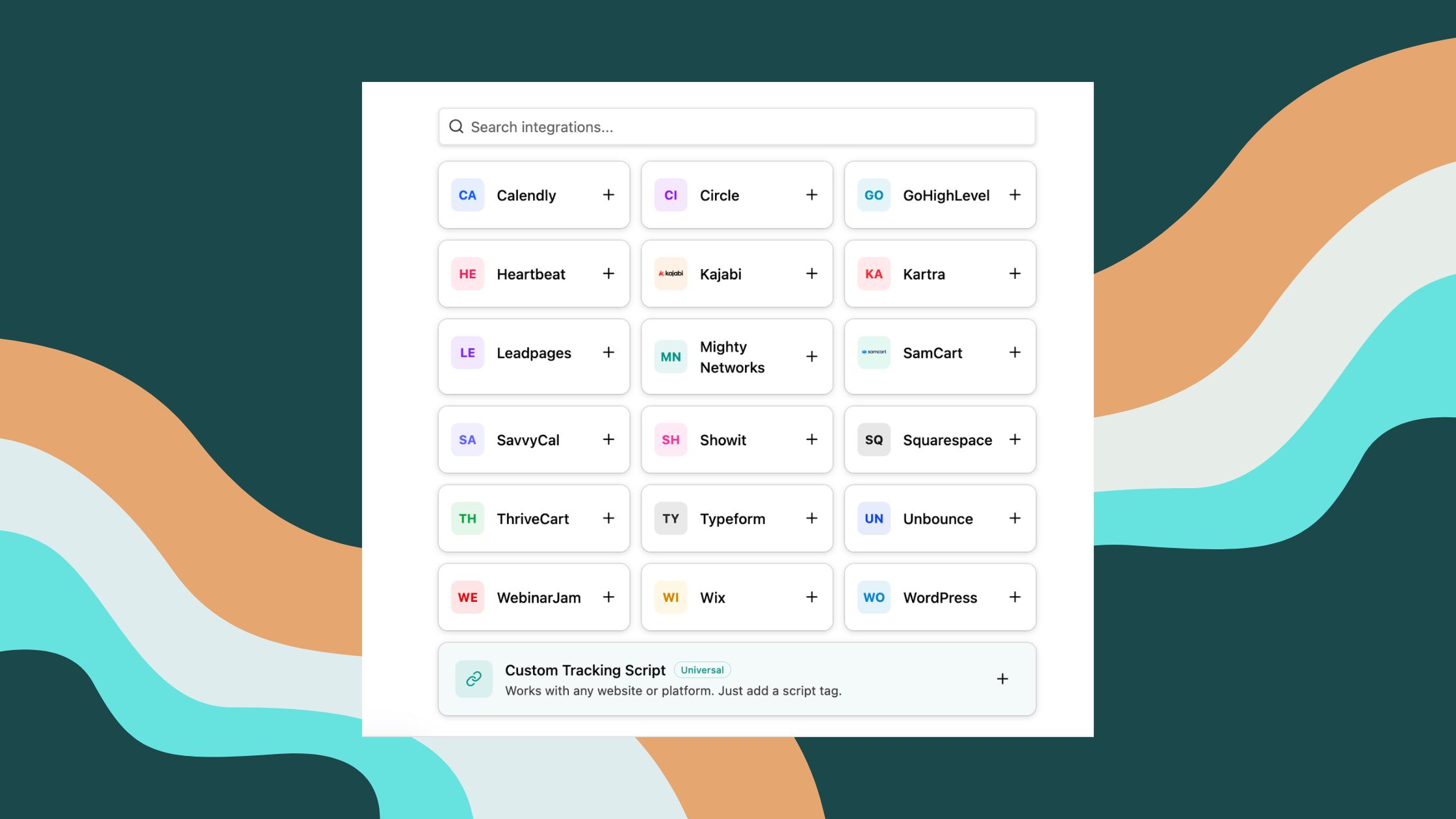
If you move to a new platform, change a sales page URL, or redirect traffic somewhere new mid-campaign, you can update the destination URL inside Rootabl without touching the affiliate links already out there in the world. Blog posts, social media posts, email sequences, anything your affiliates have already published keeps working. Their click data stays intact too.
Not on the integration list yet? Rootabl's universal tracking script is a single code snippet you can drop onto any page on virtually any platform. It captures activity and keeps attribution intact even before a native integration exists. And if you need help getting set up, Rootabl's team of actual humans can walk you through it. Just reach out at hello @ rootabl.com or use the chat inside the platform.
For course creators and digital product sellers, this means your affiliate program isn't tied to any single tool. It moves with your business, survives platform switches, and keeps your affiliates paid accurately no matter how your tech stack evolves.
If you're a course creator or digital product seller with an affiliate program, Rootabl's free trial is the easiest way to see how cross-platform tracking works in practice.
You can explore the full integrations list and connect the tools you're already using. No pressure to have everything figured out before you start. The team is there if you have questions.