.png)
Affiliate programs fail for one simple reason: they treat people like distribution channels instead of partners.
Creators enthusiastically recruit affiliates — then just hand over a link, send a few reminder emails, and hope for the best. When sales stall, the conclusion is usually that “affiliate marketing doesn’t work anymore.”
But the problem isn’t with the affiliates, it’s with the lack of a system to support them built around relationships, trust, and momentum.
That’s why I developed the Cycle of Profitable Partnerships™ — a relationship-first framework designed to help course creators build affiliate programs that are sustainable, repeatable, and genuinely enjoyable to run.
Rather than focusing on one-off launches or short-term transactions, this cycle creates a rhythm you can return to again and again — refining it each time as your program grows.
Most course creators are taught to grow their businesses in ways that quietly drain them.
You’re told to:
These approaches can work, but they often rely on extractive growth.
Extractive growth strategies pull from finite resources over and over again, like:
Organic marketing and paid advertising both fall into this category. Even when they perform well, they usually require ongoing input to maintain results. Stop posting or pause the ad spend, and growth slows or stops.
There’s nothing inherently wrong with these methods, but they don’t naturally compound on their own.
Regenerative growth systems are designed to replenish and compound rather than deplete.
Instead of asking, “How much more can I put in?” they ask, “How do I build something that continues to give back?”
Affiliate marketing — when it’s relationship-driven — is a regenerative model.
When you collaborate with partners who already have aligned audiences:
Rather than draining your resources, each successful partnership increases your capacity for the next one.
And it’s not that you have to choose affiliate marketing instead of other forms of marketing; rather, it’s a way to ensure that you have at least one system in your business that is regenerative and compounding over time.
Affiliate marketing sits at the intersection of:
Unlike ads, you’re not paying to test attention. Unlike organic content, you’re not relying solely on your own output.
You’re creating a system where partners benefit when you succeed, you benefit when they succeed, and therefore trust compounds over time.
Referred buyers are as much as four times more likely to convert than cold leads — not because of clever tactics, but because trust has already been transferred.
That trust doesn’t disappear after one promotion. It deepens.
What makes affiliate marketing truly regenerative isn’t the tactic itself; it’s the structure around it.
Without intention, affiliate programs can still become extractive.
The Cycle of Profitable Partnerships™ exists to prevent that.
By intentionally attracting aligned partners, activating them with support, amplifying momentum together, and appreciating their contribution, you create a growth system that restores energy instead of consuming it.
Each time you run the cycle, you’re not starting over, you’re building on trust, relationships, and shared wins that already exist.
And regenerative affiliate programs don’t just require the right mindset — they require the right systems.
When partners can see what’s working, get paid reliably, and feel supported without friction, the cycle becomes easier to sustain. That’s why affiliate-first platforms like Rootabl are designed around the needs of partners, not just program owners.
Traditional affiliate strategies tend to over-optimize for reach and under-optimize for connection. They tend to prioritize volume over alignment and automation over clarity
The Cycle of Profitable Partnerships™ flips that model.
It’s designed to help you:
The framework works whether you’re inviting your first two partners or managing a mature program with dozens (or hundreds) of active affiliates. The scale changes; the principles don’t.
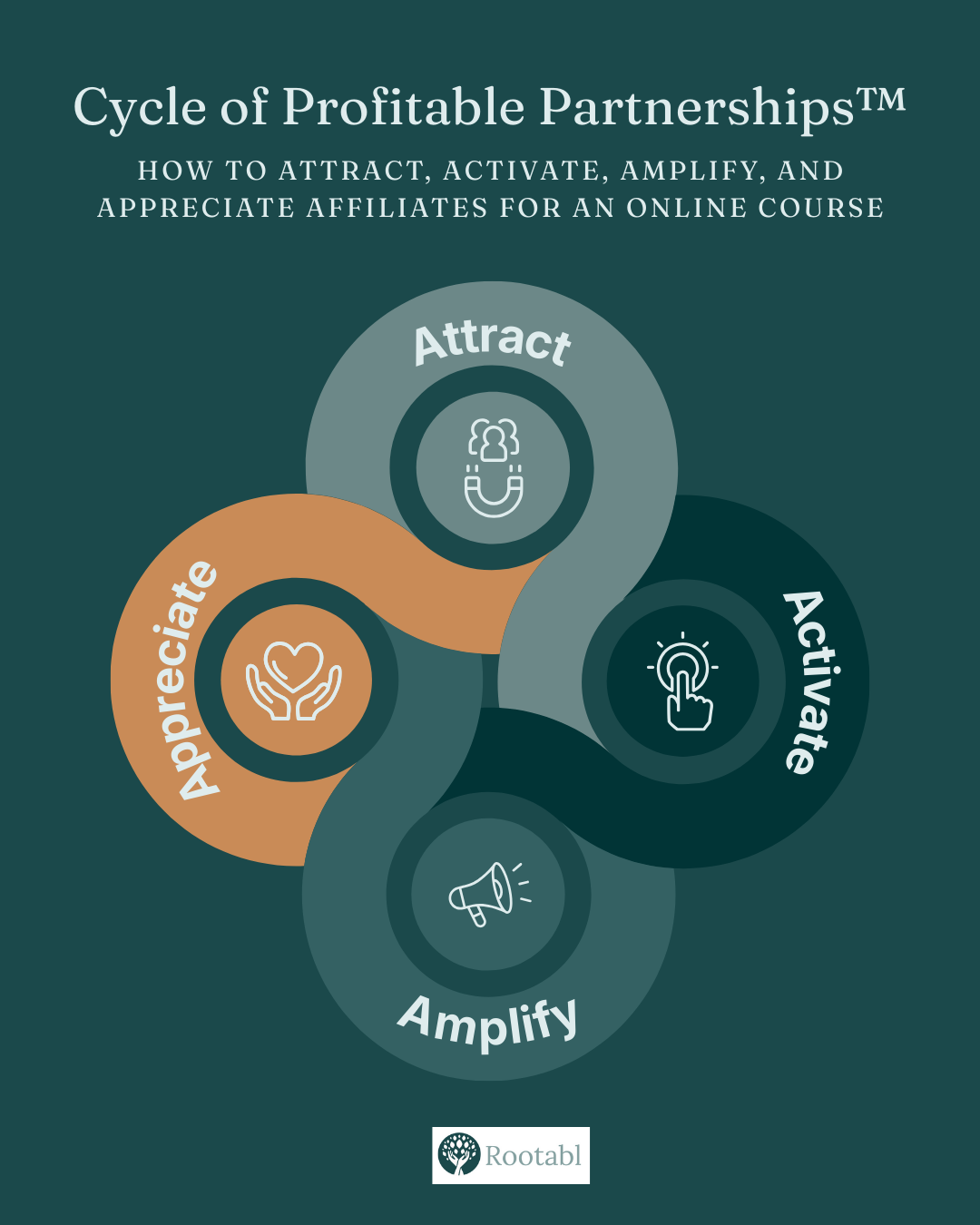
At its core, the Cycle of Profitable Partnerships™ has four phases. Each one supports the next, and skipping any of them weakens the whole system.
The goal of the Attract phase isn’t to recruit as many affiliates as possible. It’s to invite the right people into partnership.
The strongest affiliate relationships usually start close to home:
These partners already understand your work and trust the transformation you deliver. When they share your course, it feels natural — not salesy or overly promotional.
As you expand beyond your inner circle, alignment matters far more than audience size. A smaller partner who deeply connects with your message will almost always outperform a large but disconnected promoter.
Attraction, in this model, is relational. It’s about making it easy to say yes and meaningful to participate.
Most affiliate programs stall right here.
Partners join with good intentions… and then nothing happens. Not because they don’t care, but because they:
Activation isn’t about pressure, sending one more reminder email, begging for one more social media post. It’s about support.
In this phase, your role is to remove friction by:
When affiliates have to hunt for links, dig through emails, or guess what’s working, activation stalls. Centralized dashboards and transparent reporting remove that friction and make promotion feel easier and more natural. Rootabl solves this problem by providing an affiliate-first dashboard and partner ecosystem that makes everything available all in one place.
When affiliates feel confident and supported, promotion becomes an extension of their own voice — not a performance they have to psych themselves up for.
Once affiliates start sharing, your job shifts from activation to amplification.
This is where affiliate programs begin to really feel alive!
Momentum builds from:
Your amplification strategy might include leaderboards and bonuses for top performers, but it shouldn’t leave out smaller affiliates who are working hard to bring in just a handful of sales.
Amplification isn’t about competition for competition’s sake. It’s about energy. When affiliates can see that their efforts matter — and that others are showing up alongside them — participation naturally increases.
This phase transforms individual promoters into a temporary team working toward the same outcome. Think collaboration over competition and everybody wins.
Appreciation is the most overlooked phase of affiliate marketing — and the one that determines whether partners come back.
Affiliates remember:
Consistent appreciation builds loyalty. It turns one-time promotions into ongoing advocacy.
This doesn’t require elaborate rewards or bonuses. Often, it’s the small, human gestures — a thank-you message, a public shout-out, a quick check-in — that make partners feel valued and invested.
And remember: appreciation isn’t just about thank-you messages. It’s about professionalism.
Paying partners clearly and on time, showing them their numbers, and removing payout friction sends a powerful message: this relationship matters. Rootabl supports this phase by automating payouts and making performance transparent — so appreciation is built into the system, not left to memory.
Before applying the Cycle, it’s important to make sure your course — and your capacity — are ready. This guide on how to know if you’re ready to start an affiliate program will help you assess the timing honestly.
What makes the Cycle of Profitable Partnerships™ different is that it’s not a funnel or a checklist. It’s a loop.
Each time you run the cycle, you learn:
Those insights feed directly into the next round.
Over time, you spend less energy recruiting new affiliates and more time collaborating with partners who already believe in your work — and who are excited to promote again.
When affiliate marketing is treated as a tactic, it burns out quickly.
When it’s treated as an ecosystem — built on trust, clarity, and mutual benefit — it becomes one of the most sustainable growth strategies available to course creators.
Regenerative growth doesn’t happen by accident. It’s built through intention, relationships, and systems that support both.
The Cycle of Profitable Partnerships™ gives you the framework. Affiliate-first platforms give you the foundation to run it sustainably.
If you want to see how this framework translates into real-world setup, commissions, and partner workflows, the Ultimate Guide to creating an affiliate program for online courses walks through the implementation step by step.