.png)

Starting an affiliate program can feel like the obvious next step once you’ve created an online course.
You’ve built something valuable. You want more people to find it. And you’ve heard that affiliate marketing can be one of the fastest ways to grow without relying on ads or endless content.
All of that can be true.
But affiliate programs don’t work simply because you launch them; they work when the timing, structure, and mindset are right.
Before you recruit partners or set commission rates, it’s worth asking a more important question:
Are you actually ready to run an affiliate program for your course?
This guide will help you answer that honestly so you can move forward with confidence or refocus your energy where it will have the biggest impact right now.
Affiliate marketing doesn’t create demand from nothing. It amplifies what already exists.
When your course converts, your messaging is clear, and your students get real results, affiliates can help you reach new audiences quickly and authentically.
When those foundations aren’t in place yet, affiliate programs tend to stall, often in ways that feel awkward or discouraging for everyone involved.
Read through the readiness signals below. If you recognize yourself in more than one, it doesn’t mean affiliate marketing is “off the table.” It just means your next step might be something different.
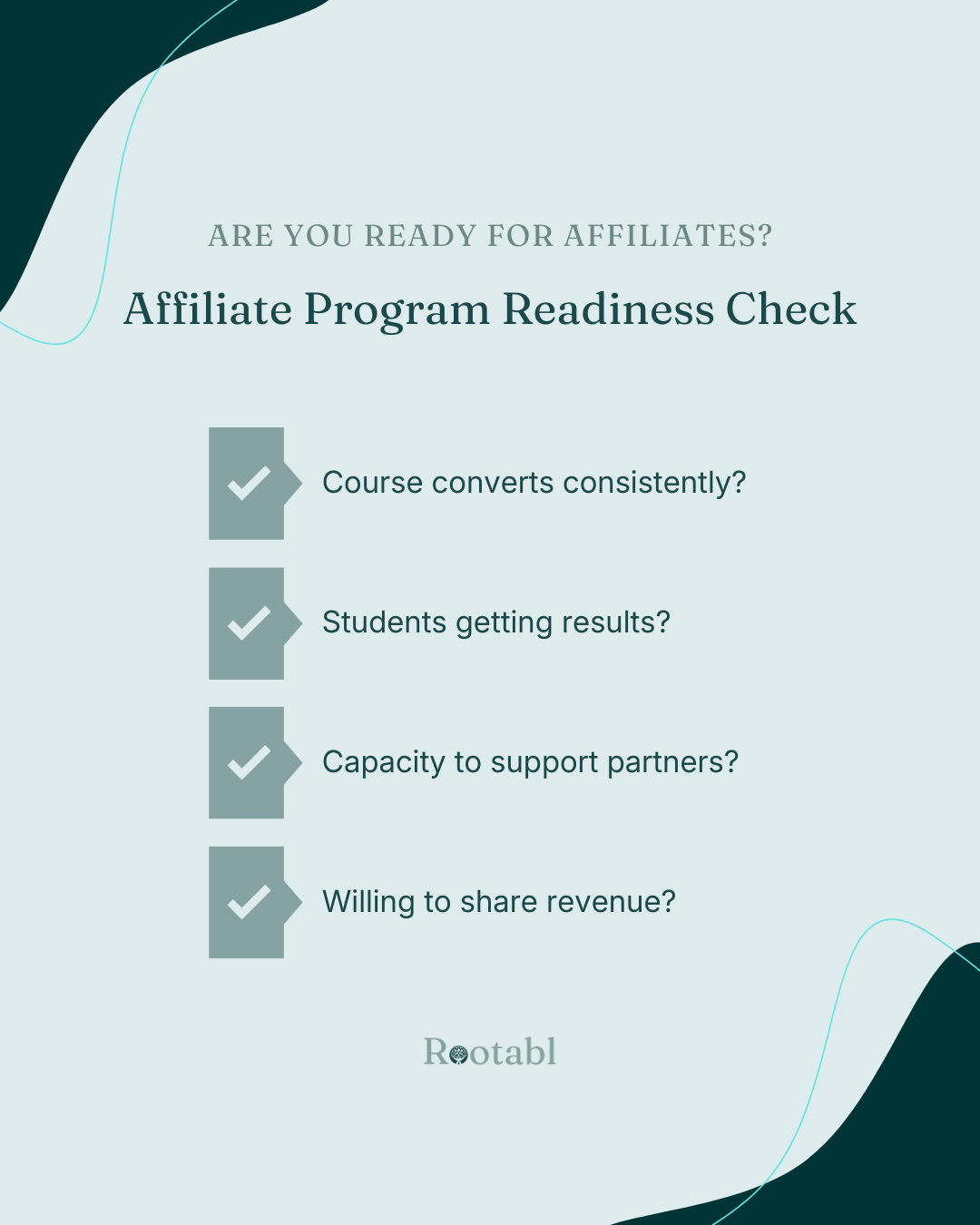
Real talk: an affiliate program won’t fix an offer that isn’t converting.
If your course hasn’t made consistent sales yet — or you’re still unsure who it’s really for — inviting affiliates too early can backfire. Partners promote with good intentions, but without proof, results are unpredictable at best.
It’s also important that your customers or students have gotten real results and demonstrated that your course delivers on its promise. Testimonials are a great way to show social proof that your course does what it says, and happy customers can make the best future affiliates.
A strong readiness signal:
You’ve sold your course multiple times, you understand why people buy, and you can point to real outcomes students have achieved.
If you’re not there yet:
Focus on refining your offer and messaging. Get your first 10–20 students through the course, collect feedback and testimonials, and tighten your sales process. That foundation makes affiliate promotion far more effective later.
Affiliate programs are powered by people, not software or links.
Even the most streamlined systems still require:
If you’re in a season where you’re stretched thin or craving simplicity, adding an affiliate program may feel like one more thing instead of a growth lever.
When you’re ready to grow through collaboration instead of pressure, the Cycle of Profitable Partnerships™ breaks down how to attract, activate, and retain affiliates in a way that compounds over time.
A strong readiness signal:
You have space — emotionally and practically — to nurture relationships and communicate consistently.
If you’re not there yet:
That’s okay. Affiliate programs aren’t urgent. They work best when you can show up with presence, not pressure.
Automation is incredibly helpful, but affiliate marketing is not a “set it and forget it” channel.
Tracking, payouts, and reporting can (and should) be automated. But the human side of partnerships still matters. Affiliates need encouragement, clarity, and recognition to stay engaged.
A strong readiness signal:
You’re willing to pair smart systems with simple, human communication.
If you’re not there yet:
Consider waiting until you’re open to blending automation with connection. The most successful affiliate programs rely on both.
Affiliate marketing is a generosity-based growth model.
It works because you’re willing to:
If paying a 30–50% commissions feels like a loss instead of an investment, resentment can creep in, and that tension tends to show.
A strong readiness signal:
You see affiliate commissions as revenue you wouldn’t have earned otherwise, not money you’re giving up.
If you’re not there yet:
Spend time reframing what partnership means in your business. Affiliate marketing thrives when everyone involved feels the exchange is fair and energizing.
Your affiliates will often see things you can’t.
They hear objections from their audiences. They notice friction in your checkout. They spot messaging gaps you might be too close to catch.
Affiliate programs work best when collaboration flows both ways.
A strong readiness signal:
You’re curious about feedback and willing to adapt based on what partners experience.
If you’re not there yet:
That’s another sign to pause. Strong affiliate relationships are built on trust, not defensiveness.
If you read this list and felt called out, that’s not a failure!
Knowing you’re not ready yet gives you a clear roadmap for what to focus on next — whether that’s refining your offer, simplifying your systems, or creating more capacity in your business.
Affiliate programs work best when they’re built on solid ground, not desperation.
When the foundations are in place — your course converts, you have capacity for relationships, and you’re ready to collaborate — the systems you choose start to matter a lot.
Affiliate programs built on trust need infrastructure that supports partners, not just program owners. Clear tracking, transparent reporting, and reliable payouts aren’t “nice to have” features, they’re what make partners feel confident promoting in the first place.
That’s why many course creators choose affiliate-first platforms like Rootabl when they’re ready to scale. These tools are designed around the realities of partnership: visibility, trust, and long-term collaboration so when you do launch an affiliate program, it’s built to last.
And when you’re ready to put an affiliate program into action, this step-by-step guide to creating an affiliate program for your online course walks through setup, structure, and execution in detail.
(No action required now. Just something to know when the timing is right.)
The ideal time to start an affiliate program isn’t when you’re scrambling for sales.
It’s when:
When those pieces are in place, affiliate marketing feels aligned — and it grows faster because of it.