.png)

Setting affiliate commissions for a monthly membership is one of those decisions that sounds simple and isn't.
You want to pay affiliates well enough that they're genuinely excited to promote your program. Real payouts. Commission rates they can get behind. And you want a structure your business can sustain as the months roll on.
With a flat percentage, those two goals can be hard to meet at the same time. A rate that really rewards affiliates at the conversion can be more than your margins sustain forever. And the rate your margins can sustain forever often isn't enough to get affiliates excited in the first place.
Most affiliate software hands you one dial to turn. A single rate across every product, every price point, every month of the subscription's life. That's fine for a one-and-done product. It's a poor fit for a membership, where the shape of the payout should match the shape of the relationship.
Rootabl's advanced commission filters, and specifically time-based commissions, let you structure a program that's genuinely good for affiliates and sustainable for your business. Different rates for different products. Different rates over time. Here's how to think about it.
Rootabl gives you two commission modes.
Standard commission is a single percentage across every sale. It's clean and simple, and it works beautifully for straightforward programs with one core offer.
Advanced commissions let you build rules. Different rates based on price, product name, product ID, or date. This is where you go when you have multiple offers at different price points, low-ticket products that lead into higher-ticket programs, things you want to exclude from commissions entirely, or a membership where a flat rate just doesn't reflect how the relationship actually works.
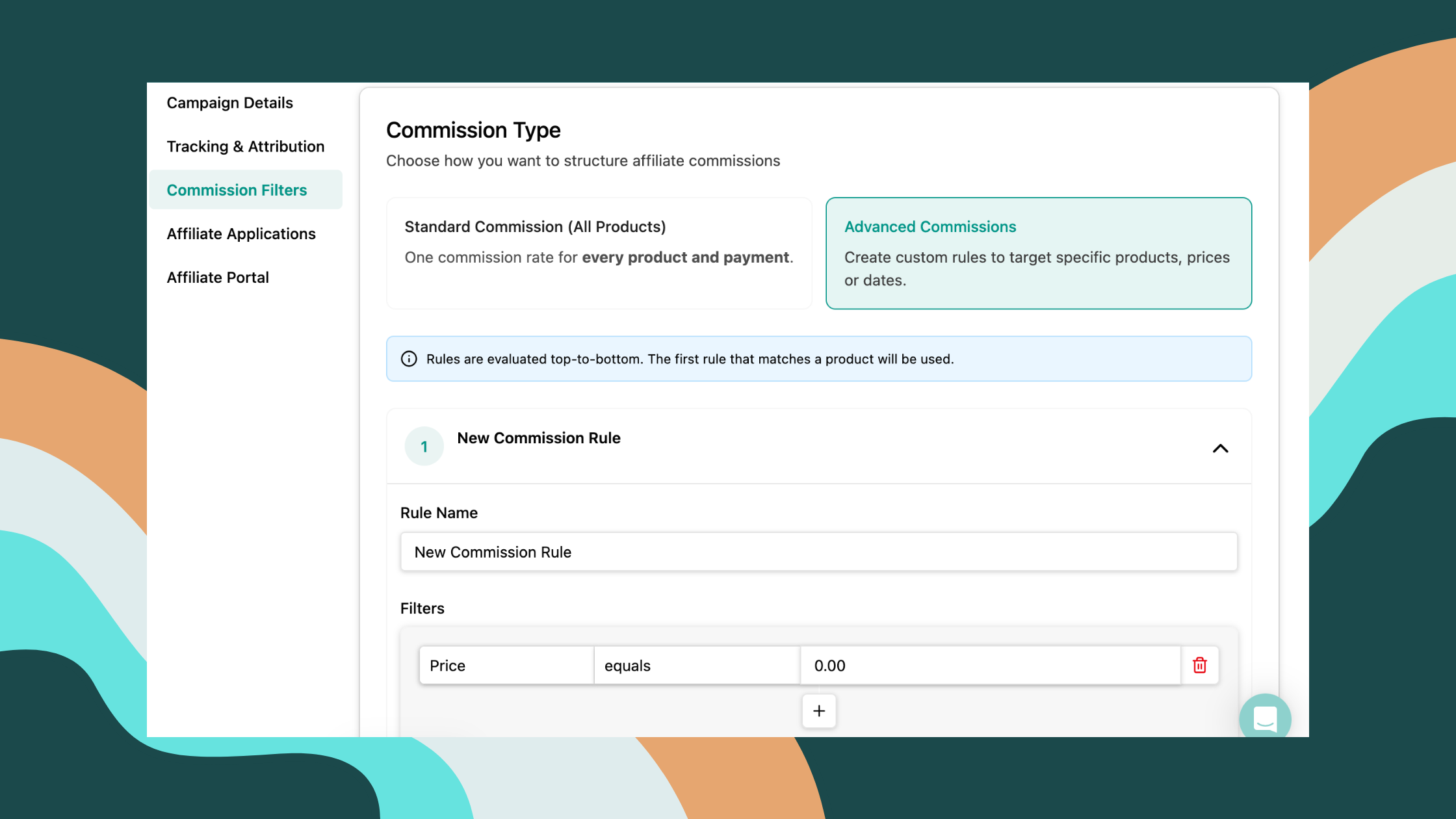
Most membership site owners need advanced commissions. The rest of this post is for you.
Before we get to time-based commissions, here are a few more things advanced commission filters let you do.
You have a $20 workshop and a $500 program. The workshop is your entry point. You want affiliates excited to drive that first conversion.
With commission filters, you can set 90% on the $20 workshop and 20% on the $500 program. Affiliates get a meaningful payout on the entry product, which makes it worth promoting. The workshop revenue is almost entirely theirs. The deeper relationship with the customer grows from there: the program, the upsells, the retention, the ongoing value.
That's not possible on a flat standard commission. With advanced filters, it's a few clicks.
Some things shouldn't be commissionable. A free opt-in. A low-margin product. A piece of your catalog you're retiring. Advanced filters in Rootabl let you exclude by product name, product ID, or price without disrupting the rest of your program.
Here's where Rootabl does something most affiliate software doesn't. When an affiliate sends someone to a free opt-in, that person still shows up in the affiliate's dashboard as a lead when the business has Leads Lists set up. No commission changes hands (free is free), but the affiliate can see that their link is working. They'll see the free download sign-ups, the webinar registrations, the email list opt-ins their promotion is driving. That visibility matters, because an affiliate who can see their link is working is an affiliate who keeps promoting.
Most affiliate platforms ignore free opt-ins entirely. No visibility, no way for affiliates to know whether their promotion did anything at all. Rootabl tracks and shows it, so your affiliates stay engaged even when they're pointing traffic at a free entry point.
What is lead tagging in affiliate marketing? Lead tagging gives affiliates visibility into the leads their links are bringing in, not just the sales. When someone clicks an affiliate's link and opts in to something free (a download, a webinar, an email list), that person shows up in the affiliate's dashboard. So affiliates can see their promotion is working long before any sale comes through.
Want to pay your top affiliates more than your general pool? You can set up separate campaigns with separate commission rules. Same platform, different rates, different affiliate experiences. Silver-tier affiliates get one rate. Gold-tier affiliates get another. Both run inside Rootabl without adding complexity on the backend.
A flat rate on a recurring product keeps things simple. The same percentage in month one as month eighteen. That's one valid choice that works well for some programs. For many memberships, a structure that can flex with the relationship works better: more reward at the start (where affiliate effort is heaviest), and a shape that fits your margins from there.
Time-based commissions let you set up to three stages that automatically shift based on how long a customer has been paying. You pick the rate at each stage and when the transitions happen.
Here are four structures that work well for membership programs. The right one for you depends on your margins, your retention, and how you want to think about the affiliate partnership.
1. Flat rate
One percentage, every recurring payment, for as long as the customer stays. Simple and predictable. Works if your margins hold steady and you want to reward affiliates for the full lifetime of the customer.
Example: 20% forever on a $49/month membership.
2. Two-stage time-based
A higher rate at the start, then a steady ongoing rate once the relationship settles in. Good for memberships where you want to front-load the reward without winding commissions all the way down.
Example: 50% in month one, then 15% from month two onward.
3. Three-stage time-based
A generous first-month rate, a solid year-one rate, then an ongoing rate for the long haul. Works well when retention is strong and you want the payout shape to match the intensity of the affiliate's work over time.
Example: 90% in month one, 30% for months 2 to 12, 10% from month 13 onward.
4. Time-limited (generous upfront, capped duration)
A single generous rate for a set period, then commissions end. Lets you be more generous than a flat rate while keeping your long-term economics clean.
Example: 50% for the first year, then nothing.
Each of these is a real option inside Rootabl. Because time-based stages are configurable, you can adjust the numbers and the transitions to fit your program.
What are time-based affiliate commissions? Time-based affiliate commissions are rates that automatically change based on how long a referred customer has been paying. Instead of one flat rate applied to every payment indefinitely, you can set up to three stages with different rates (or no commission at all) at each stage. This model fits membership sites, subscription boxes, and any recurring offer where a single flat rate doesn't quite capture the shape of the affiliate partnership.
What is a recurring affiliate commission? A recurring affiliate commission is a commission paid to an affiliate each time a referred customer makes a recurring payment, monthly or annually. Most affiliate software applies the same rate indefinitely. Time-based commissions give you control over the rate at each stage, so you can be generous when it matters most and structure the rest to fit your program.
Setting rates is a business decision, not a checklist item. Here's how to approach it.
Start with your offers. Think about how they fit together. A low-priced workshop that reliably leads into a bigger program can support a generous commission on the workshop itself, because the backend offer is where your real margin lives. A high-ticket program with real fulfillment costs might call for a tighter number. And some offers (free ones, thin-margin things you'd rather leave out) shouldn't pay commission at all.
For help picking actual percentages, we've got a whole post on that.
Think about the shape first, the numbers second. Where do you want to concentrate the reward? A lot of strong membership programs front-load commission around the conversion (where affiliate effort is highest) and adjust from there. That might mean a steady ongoing rate. It might mean ramping down over time. It might mean ending commissions after a set period. Pick the shape that fits your program first, then fill in the numbers.
Treat your affiliates like partners. Every time an affiliate recommends your program to the next person, they're reintroducing your brand all over again. Whatever shape you pick, pick one you can stand behind: generous enough that affiliates want to promote it, and structured so your numbers can sustain it.
Model it out. Run the numbers on real customer lifetime values before you set anything. An hour with a calculator now saves a lot of second-guessing later.
What is an affiliate commission filter? An affiliate commission filter is a rule that determines when and how a commission rate applies. Instead of one flat rate on every sale, commission filters let you set different rates based on product price, product name, product ID, or date. Filters are applied in sequence and can be stacked. In Rootabl, you can combine commission filters with time-based stages to build a structure that matches the actual shape of your business.
The commission options in Rootabl are deep. That's on purpose: different programs need different shapes, and we wanted the tool to match.
Deep doesn't have to mean overwhelming. Most programs only use two or three rules to get this right. And for the edge cases, the multi-campaign setups, the complex catalogs, the "wait, is this going to do what I think it's going to do" moments, the Rootabl team is here. We check commission logic all the time. If you want a second set of eyes on your setup before you go live, just reach out. (Real humans, not a bot.)
If you're already a Rootabl user running a membership on a flat commission, your Commission Settings are worth another look. Advanced Commission is under your campaign settings, and the time-based option is there when you're ready.
If you're still evaluating Rootabl: for membership programs, flexibility here makes a real difference. Most affiliate software gives you one rate across every product and every payment. Rootabl lets you build the structure that fits how your program actually works.
Start your free trial of Rootabl