.png)

Most affiliate programs operate in the dark.
An affiliate grabs their tracking link, shares it with their audience, and then waits. Maybe someone clicks. Maybe someone buys. But between the share and the sale? Complete silence.
That silence creates a problem.
Without visibility into who's actually responding to their promotion, affiliates can't follow up with context. They can't send a personal "See you at the webinar on Tuesday" message or check in during a free trial. They're stuck choosing between doing nothing or sending generic broadcast emails that feel disconnected from the actual opt-in.
And here's what that costs you: affiliates who could be nurturing warm leads with timely, relevant follow-up are instead either going quiet or treating every lead like a cold prospect.
But it doesn't have to work that way.
When affiliates can see exactly who clicked their link and signed up for your webinar, free trial, quiz, or lead magnet, everything changes. They move from broadcasting into the void to following up with real people who just raised their hand. The context is there. The timing is right. The follow-up feels helpful instead of salesy.
This is what lead transparency looks like in an affiliate program. And for most platforms? It doesn't exist.
In this post, you'll learn:
If you've ever wondered why your affiliates aren't following up with the people who engage with their content, this is probably why.
Most affiliate software was built with one primary use case in mind: e-commerce.
Click a link. Buy a product. Track the sale. Pay the commission.
But course creators, coaches, and membership site owners don't operate that way.
Here's what traditional affiliate platforms show affiliates:
✓ Click counts
✓ Sales
✓ Commission earned
Here's what they don't show:
✗ Who signed up for your webinar
✗ Who started a free trial
✗ Who downloaded your lead magnet
✗ Who filled out an application
✗ Who's currently in your funnel but hasn't purchased yet
That gap creates what I call the black box problem. Your affiliates are promoting, people are responding, but there's zero visibility into who those people are until a sale happens.
And for many affiliates, that lack of visibility kills momentum before it even starts.
When affiliates can't see who's engaging with their promotions, three things break down:
1. Follow-up becomes impossible
Your affiliate promotes your free webinar. Five people sign up using their link. But the affiliate has no idea who those five people are, so they can't:
Instead, those five warm leads get the same generic experience as everyone else. The personal connection that made them trust the affiliate in the first place? It disappears the moment they click the link.
2. Affiliate confidence drops
Affiliates need proof their promotion is working. When the only signal they get is "sale or no sale," it's incredibly demotivating, especially early on when conversions take time to build.
Imagine promoting a webinar funnel where the typical buyer journey is:
If an affiliate can't see the signups on Day 1, they have no idea whether their promotion is working for two full weeks. That's a long time to wonder if you're wasting your effort.
3. Generic blasts replace strategic follow-up
Without knowing who opted in through their link, affiliates face a choice: stay silent or send broad, untargeted emails to their entire list.
Most choose the broadcast approach. They send the same "Hey, have you checked out this free training?" message to everyone, whether that person already signed up three days ago or has never heard of your offer.
It works sometimes. But it's nowhere near as effective as a well-timed, contextual follow-up to someone who just took action.
The black box problem doesn't just hurt conversion rates. It trains affiliates to treat promotion like a one-and-done task instead of an ongoing relationship-building opportunity.
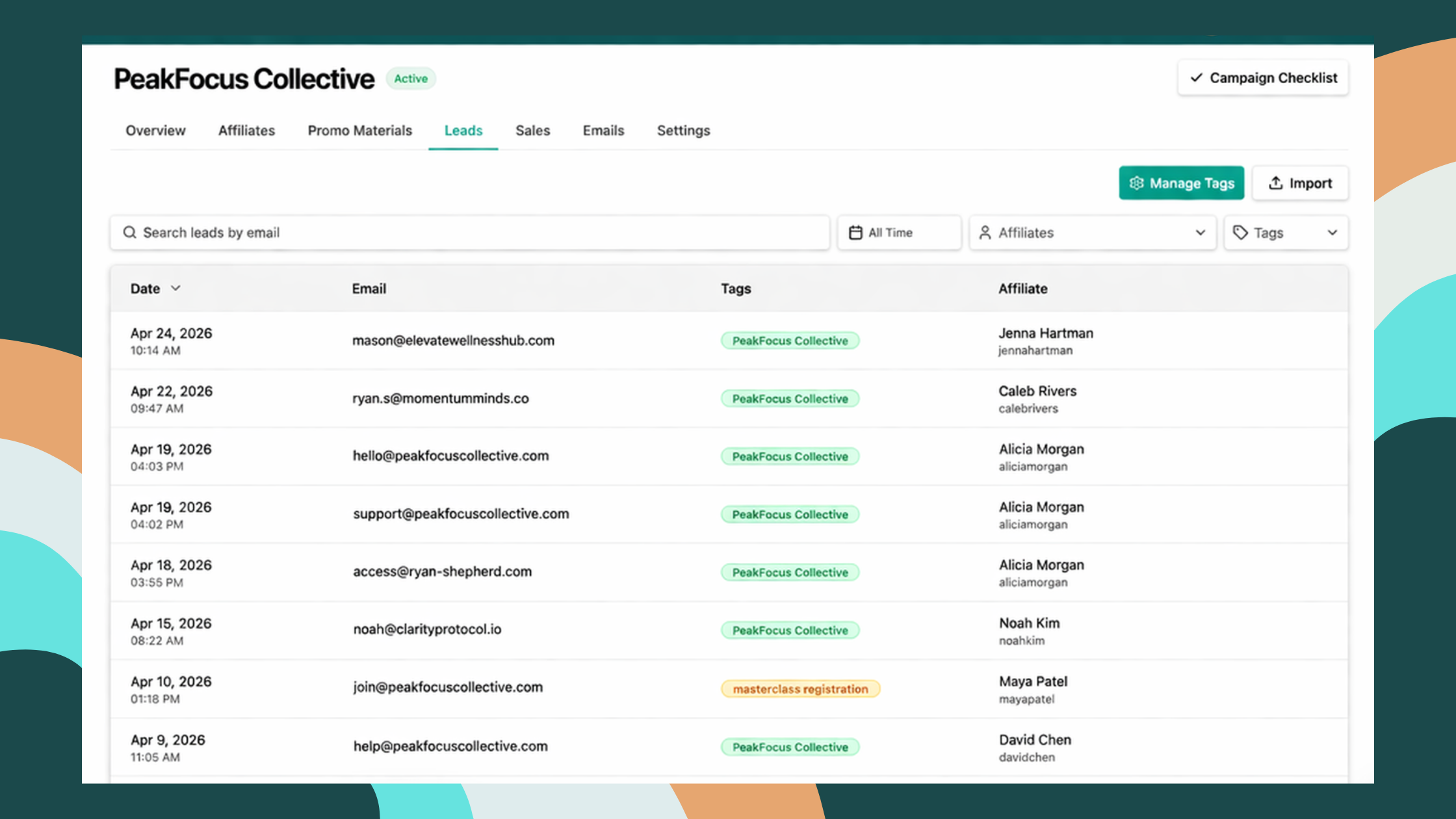
Here's what the experience looks like when lead visibility is built into your affiliate program:
Your affiliate shares their tracking link to your free webinar signup page. Over the next two days, three people use that link to register: Sarah, Mike, and Jennifer.
Instead of wondering whether anyone responded, your affiliate logs into their portal and sees:
Recent Leads:
Now the affiliate can follow up with actual context:
"Hey Sarah! I saw you signed up for the webinar on Tuesday. I'm going to be there too and I think you're going to love what [Your Name] shares about [topic]. Let me know if you have any questions before then!"
A personal touchpoint from someone the lead already trusts, sent at exactly the right moment, referencing the specific action they just took is so much more effective than an impersonal broadcast.
And if your affiliate wants to take this even further?
Rootabl integrates with Zapier, which means affiliates can automate personalized follow-up while keeping it feeling human. They can set up a Zap that triggers whenever someone signs up through their link, automatically adding that lead to a specific email sequence, tagging them in their CRM, or sending a Slack notification so they never miss an opportunity to reach out.
The lead visibility gives them the awareness; the Zapier integration gives them the systems to act on it without manually checking their portal every hour.
This is how affiliates scale personal follow-up without it becoming a full-time job.
The affiliate isn't guessing. They're not sending the same message to 500 people hoping it lands with the right ones. They're having real conversations with real people who are actively engaged.
And those conversations? They convert.
Lead visibility doesn't just make follow-up possible. It makes follow-up strategic.
When affiliates can see who opted in and when, they can time their communication for maximum impact:
Right after signup: A quick "excited to see you there" message while enthusiasm is high
The day before the event: A reminder with a personal note about what to expect
After the webinar: A check-in asking what resonated most
During a free trial: Tips for getting the most out of the trial period
After an application: Encouragement to complete it or offer to answer questions
Each of these touchpoints increases the likelihood that the lead will show up, engage, and ultimately buy.
Compare that to the affiliate who has no idea anyone signed up. They might send one generic email to their whole list a week later saying "Don't forget to register!" to people who already registered days ago.
Context matters. Timing matters. And both require visibility.
There's also a psychological component here. When someone receives a personal follow-up referencing the specific thing they just did, it reinforces that their action mattered. It creates a thread of accountability and connection that a mass email simply cannot replicate.
The sale becomes less about convincing and more about supporting someone through a decision they're already considering.
One of the quietest reasons affiliate programs stall is that affiliates lose confidence before they see results.
They promote once or twice, hear nothing back, assume it's not working, and quietly stop trying.
Lead visibility solves this by giving affiliates proof of progress early.
Even if a sale takes two weeks to close, the affiliate sees activity on Day 1. They see that people are responding. They see their promotion is working. That early validation keeps them engaged long enough to see the sales start coming in.
Affiliates who see activity stay active. Affiliates who see nothing tend to disappear.
And here's the bonus: when affiliates can see their leads engaging, they're more likely to promote again. They've experienced proof that their audience responds. They've built confidence in the offer. And they've seen that the system works.
Lead transparency doesn't just improve conversions. It improves retention of your best affiliates.
Before we dive into the mechanics of setting up lead lists, it's worth understanding where this feature fits in the bigger picture of building a sustainable affiliate program.
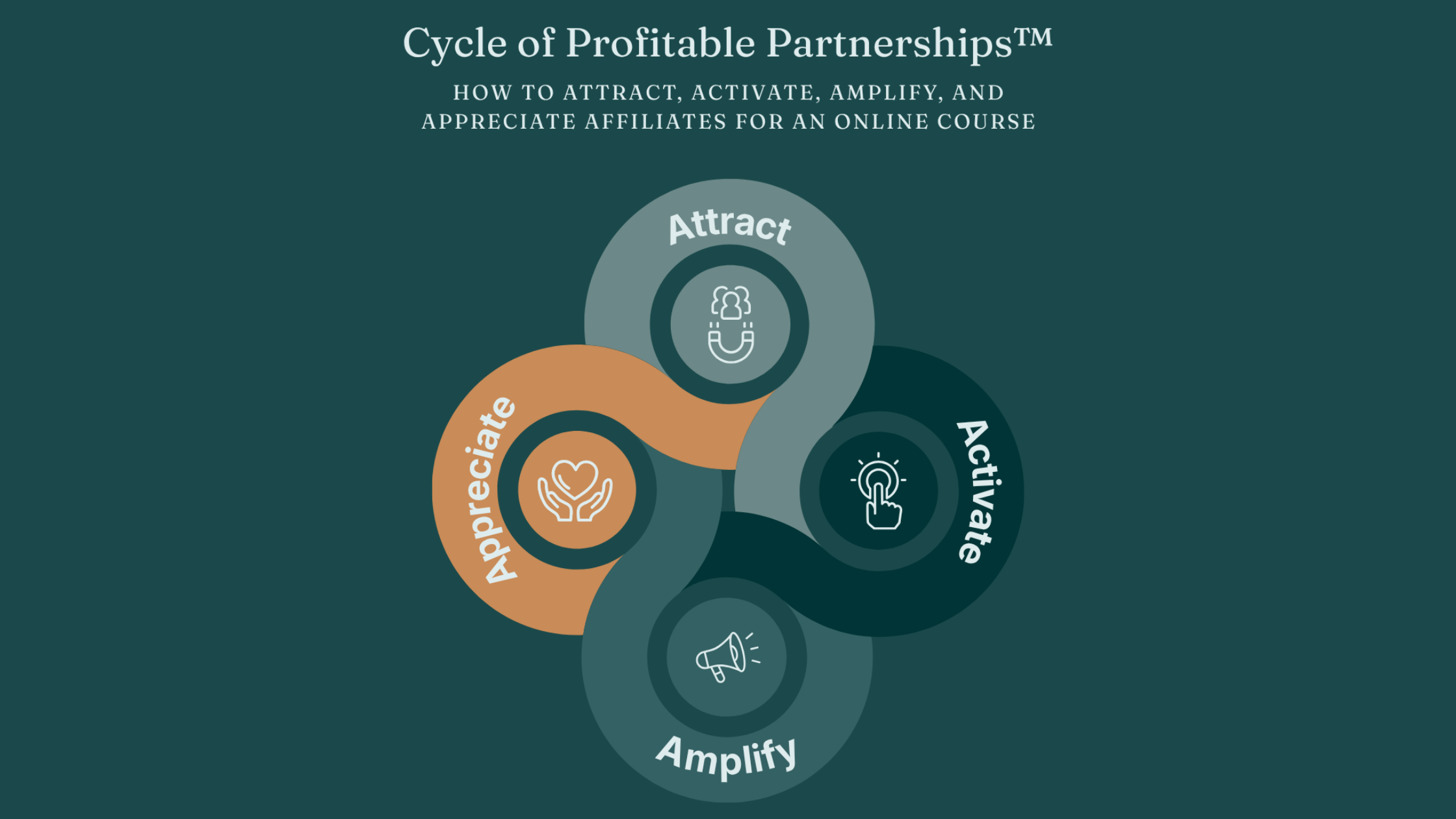
At Rootabl, we use a framework called the Cycle of Profitable Partnerships™ to help course creators build affiliate programs that grow through relationships, not pressure.
The cycle has four phases:
Attract: Invite aligned partners who genuinely connect with your work and audience.
Activate: Equip affiliates with the tools, resources, and confidence they need to promote effectively.
Amplify: Create visibility, energy, and momentum together through community and celebration.
Appreciate: Recognize, reward, and retain your best affiliates so they keep coming back.
This isn't a linear checklist. It's a loop. Each time you run through the cycle, you strengthen relationships, refine your systems, and build on the trust that already exists.
Lead visibility isn't just a tactical feature. It's a strategic advantage that supports every single phase of this cycle.
The Amplify phase is all about creating visibility and momentum together.
It's where affiliates see proof that their promotion is working. It's where energy builds during a launch or evergreen campaign. And it's where individual promoters start to feel like part of something bigger.
Lead lists are a core Amplify tool because they give affiliates real-time visibility into their impact.
When an affiliate logs into their portal and sees that five people signed up for your webinar through their link, that's not just data. That's proof. Proof that their audience is responding. Proof that their message is landing. Proof that this partnership is working.
And that proof drives action.
Affiliates who can see their leads are more likely to follow up, more likely to promote again, and more likely to stay engaged through the entire sales cycle. They're not waiting in the dark wondering if anything is happening. They can see the momentum building in real time.
This is what amplification looks like when it's built into the system, not forced through motivation.
While lead lists are an Amplify feature at their core, the impact ripples through the entire cycle:
In the Attract phase: Offering lead visibility makes your affiliate program more appealing to high-quality partners. When potential affiliates ask "What's different about your program?" being able to say "You'll see everyone who opts in through your link, not just who buys" is a big differentiator. It signals that you're running a creator-first program, not a transactional one.
In the Activate phase: New affiliates might hesitate because they're not sure if promotion will work. Showing them lead data early builds confidence. Even if sales take time to materialize, they can see signups happening within hours of their first promotion. That early validation keeps them engaged long enough to see results.
In the Amplify phase: This is where lead lists shine. Real-time visibility creates energy, enables strategic follow-up, and turns passive promotion into active relationship-building.
In the Appreciate phase: Recognizing affiliate effort before sales happen builds long-term loyalty. When you can acknowledge that an affiliate drove 20 webinar signups even if only 3 converted to sales, you're appreciating the full scope of their contribution. And affiliates who feel seen for their effort, not just their sales, are far more likely to promote again.
Lead transparency isn't just about tracking data. It's about building trust, supporting relationships, and creating a program where affiliates feel informed, empowered, and valued at every stage.
If you want to dive deeper into how the Cycle of Profitable Partnerships™ works and how to apply it to your affiliate program, we've written a full breakdown here.
Let's clarify what we mean by a "lead" in the context of affiliate marketing.
A lead is someone who has opted in for something free using their email address.
Unlike a sale, where someone purchases a product, a lead has raised their hand to indicate interest without making a financial commitment yet.
Leads are typically gathered through:
If your business model includes any of these, you're already collecting leads. The question is whether your affiliates can see which leads came through their promotion.
One important note: If you don't currently have any kind of free opt-ins as part of your sales process, you can skip lead tracking for now. This feature is designed specifically for businesses that use lead magnets or free content as part of their funnel. If you sell directly without a lead capture step, you won't need it.
When you set up a campaign in Rootabl, you create tracking links for your affiliates to share. These links track clicks and sales automatically.
But if you also want to track leads, you add what's called a Lead List Tag to specific URLs in your funnel.
A Lead List Tag tells Rootabl: "When someone clicks an affiliate link and lands on this URL, capture their email as a lead and show it in that affiliate's portal."
For example, let's say your webinar registration page is at:
https://yoursite.com/free-webinar-signup
You add that URL as a Lead List Tag in your campaign settings and label it "Spring Webinar."
Now, when someone:
Rootabl captures that email and displays it in the affiliate's portal under "Recent Leads" with the tag "Spring Webinar."
The affiliate sees the lead almost immediately. No manual tracking. No spreadsheets. No guessing.

From the affiliate's perspective, the experience is simple and transparent.
They log into their Rootabl affiliate portal and navigate to their dashboard. Under the "Leads" section, they see a list of everyone who opted in through their link, including:
If you've set up multiple Lead List Tags (for example, one for your webinar, one for your free trial, and one for your quiz), affiliates can see all of their leads organized by type.
This visibility happens in real time. An affiliate doesn't have to wait for you to send them a report or manually pull data. The moment someone opts in, it shows up in their portal.
And because Rootabl integrates with Zapier, affiliates can also set up automations to notify them whenever a new lead comes in, so they can follow up immediately without constantly refreshing their dashboard.
The actual setup process is straightforward and takes about 10 minutes.
You'll add the URLs where people opt in (your webinar page, free trial signup, etc.) as Lead List Tags in your campaign settings, give each one a descriptive label, and test to make sure leads are showing up correctly in the portal.
We've documented the complete step-by-step process here: How to Set Up Leads Lists.
The Setup:
Jessica runs a course on content marketing for service providers. Her sales funnel starts with a free 60-minute webinar where she teaches a framework, then pitches her full course at the end.
She has 15 active affiliates promoting her webinar registration page.
Without Lead Visibility:
Jessica's affiliates share their links and hope people register. Some affiliates send one reminder email. Most don't follow up at all because they have no idea if anyone signed up.
When the webinar happens, Jessica sees 200 registrants but only 70 show up live. Of those 70, maybe 10 buy during the live pitch.
Her affiliates who drove registrations? They have no idea their promotion worked until a sale notification appears days later. Many assume nothing happened and stop promoting.
With Lead Visibility:
Now Jessica's affiliates can see exactly who registered through their link.
One affiliate, Maria, checks her portal the day after sharing her link. She sees 12 people registered for the webinar, including three people she knows personally from her own community.
Maria sends each of them a quick personal message:
"Hey! I saw you signed up for Jessica's webinar on Thursday. I've been through her course and it completely changed how I approach content strategy. Let me know if you have any questions before the session!"
She also sends a reminder the day before: "Looking forward to seeing you at the webinar tomorrow! Grab a notebook because Jessica moves fast."
The Result:
Maria's 12 registrants have a significantly higher show-up rate than the general registration list because they received personal touchpoints from someone they trust. More show-ups means more people hear the pitch. More people hearing the pitch means more sales.
And even if some of them don't buy immediately, Maria can continue following up during the replay period because she knows exactly who attended through her link.
Her conversion rate from lead to sale is nearly double the program average because of strategic, timely follow-up.
The Setup:
David runs a membership community for freelance designers. He offers a 7-day free trial, after which members can choose to stay on for $49/month.
He has 8 affiliates promoting the free trial.
Without Lead Visibility:
David's affiliates share their trial link. People start trials. Affiliates have no idea who or when.
The trial period is only 7 days, which means the window for influence is extremely short. But without knowing who's in a trial, affiliates can't do anything to help those people get value and convert to paid.
Trial-to-paid conversion sits around 30%.
With Lead Visibility:
Now David's affiliates can see when someone starts a trial through their link.
One affiliate, Rachel, gets a notification through her Zapier integration that someone named Tom just started a trial. She sends him a message on Day 2:
"Hey Tom! I saw you started the free trial. I've been a member for six months and it's been incredible for my design business. If you want any tips on getting the most out of it, let me know. The resource library alone is worth the membership."
On Day 5, she checks in again: "How's the trial going? Have you checked out the portfolio critique sessions yet? They happen every Tuesday and they're one of my favorite parts."
The Result:
Rachel's trial-to-paid conversion rate jumps to 52% because she's actively helping people see value during the critical trial window. She's not selling. She's supporting. But that support directly influences whether someone stays or cancels.
David notices that affiliates who engage with their trial leads convert at nearly 2x the rate of affiliates who don't. He starts encouraging all affiliates to use the lead visibility feature and provides them with a simple follow-up template.
Overall trial-to-paid conversion across the program increases by 15 percentage points.
The Setup:
Laurel runs a high-ticket group coaching program for online business owners. Interested buyers must fill out an application, then book a call with Lauren to see if they're a fit.
She has 5 affiliates promoting the application.
Without Lead Visibility:
Laurel's affiliates promote the application link. Some people start the application, but many don't finish it because it's fairly detailed. Affiliates have no idea who applied, who started but didn't finish, or who booked a call.
Application completion rate is around 60%. Of completed applications, about 70% book a call.
With Lead Visibility:
Now Lauren's affiliates can see when someone submits an application through their link.
One affiliate, Marcus, sees that his colleague Sarah applied two days ago. He sends her a text:
"Hey! I saw you applied for Lauren's program. That's amazing. I went through it last year and it completely shifted how I think about scaling. Let me know if you have any questions before your call with her."
Sarah replies: "I actually haven't booked the call yet because I wasn't sure if I was ready. But hearing that from you makes me feel better about it."
Marcus: "You're absolutely ready. Book the call. Worst case, Laurel helps you figure out timing. Best case, you're in the next cohort and we can compare notes."
Sarah books the call. She joins the program.
The Result:
Marcus didn't have to guess who was interested or send a blanket "Have you checked this out?" message to his whole network. He saw exactly who took action and was able to provide timely, personal encouragement at the exact moment it mattered most.
Laurel notices that applications referred by affiliates who actively engage with their leads have a 90% call-booking rate compared to 70% overall. Those personal nudges make a measurable difference.
Most affiliate software was designed for a very specific use case: selling physical products or simple digital goods through e-commerce stores.
In that model, the customer journey is short and straightforward:
There are no webinars, no lead magnets, no free trials, no applications, no multi-step funnels that nurture someone over days or weeks before they buy.
In an e-commerce model, tracking leads doesn't make sense because there are no leads to track. The only meaningful action is the purchase.
So traditional affiliate platforms optimized for one thing: attribution of sales.
But course creators, coaches, membership site owners, and digital product sellers operate completely differently.
Your business model is relationship-driven and funnel-based. You're not asking someone to impulse-buy a $30 product. You're inviting them into a webinar, offering a free trial, or asking them to complete an application for a high-ticket program.
The sale might happen two weeks or more after the first click. And during those two weeks, the quality of follow-up from the affiliate can make or break the conversion.
That's why lead visibility matters so much in the creator economy. It's not a nice-to-have feature. It's fundamental to how creator businesses actually grow.
Rootabl was built specifically for course creators, coaches, and membership site owners.
We didn't adapt e-commerce software to work for courses. We started from scratch with a simple question: What do creator-led businesses actually need from an affiliate program?
And one of the clearest answers was this: Affiliates need to see the full picture of their impact, not just the final sale.
That's why lead tracking isn't an add-on feature or a workaround in Rootabl. It's native to the platform.
When you set up a campaign, you can add as many Lead List Tags as you want. Webinar signups, free trial starts, quiz completions, application submissions: all of it can be visible to your affiliates in real time.
This approach reflects a fundamental difference in philosophy.
Traditional affiliate platforms treat affiliates as a distribution channel. You hand them a link, track the sale, pay the commission, repeat.
Rootabl treats affiliates as partners. We build tools that help them succeed, not just tools that track their performance. Lead visibility is one of those tools. Transparent commission structures, Done-For-You Payouts, and Zapier integrations are others.
When affiliates have the information and systems they need to do their job well, everyone wins. They convert more leads. You make more sales. And the partnership strengthens over time instead of fading after one campaign.
This is what happens when you design affiliate software for the way creator businesses actually work, not for how e-commerce stores operate.
No. Lead tracking is designed specifically for businesses that use free opt-ins as part of their sales funnel.
If you sell your course, membership, or coaching program directly without any lead capture steps in between, you don't need this feature. Your affiliates will still see clicks and sales, which is all the visibility they need for a direct-sale model.
But if you're thinking about adding a lead magnet, free training, or trial offer to your funnel in the future, lead tracking will be ready when you are.
Affiliates see the information that leads provide when they opt in, which typically includes:
They do not see any additional personal information, purchase history, or data beyond what's directly related to that specific opt-in.
This level of visibility is intentional. It gives affiliates enough information to follow up personally and contextually without exposing sensitive data.
You can set up as many Lead List Tags as you need.
For example, you might have:
Each one gets its own URL and tag. Leads are organized by tag in the affiliate portal, so affiliates can see exactly which opt-in someone responded to.
This is especially helpful if you run multiple campaigns or evergreen offers simultaneously. Affiliates can track performance across different promotions and adjust their strategy based on what's resonating with their audience.
Lead tracking works through URL-based tagging, which means it's platform-agnostic.
Whether you're using Kajabi, Teachable, Thinkific, ClickFunnels, WordPress, Webflow, or any other platform to host your opt-in forms, as long as you can add the Rootabl tracking script to your site and direct people to a specific URL for your opt-in, lead tracking will work.
You simply add the URL of your opt-in page as a Lead List Tag in your Rootabl campaign settings. When someone lands on that page after clicking an affiliate link and submits the form, Rootabl captures them as a lead.
If you have questions about your specific tech stack, the Rootabl support team can help you verify compatibility and walk through setup.
Most affiliate programs fail not because affiliates don't care, but because they're operating in the dark.
When affiliates can't see who's responding to their promotion until a sale happens, follow-up becomes guesswork. Context disappears. Timing gets missed. And what could have been a personal, strategic touchpoint turns into a generic broadcast or nothing at all.
Lead transparency changes that.
When affiliates can see exactly who clicked their link and signed up for your webinar, free trial, quiz, or lead magnet, they move from hoping something happens to actively making it happen. They follow up with real people at the right moment with the right context. And those conversations convert.
But lead visibility isn't just a tactical win. It's a strategic advantage that strengthens every phase of building sustainable affiliate partnerships.
The setup takes about 10 minutes. You add the URLs where people opt in, tag them with descriptive labels, and test to make sure everything's working. That's it.
And the impact? Affiliates who can see their leads convert at significantly higher rates than affiliates who can't. They stay engaged longer. They promote more consistently. And they build the kind of trust with their audience that turns one-time buyers into long-term customers.
Start your free trial of Rootabl today and see what happens when your affiliates can finally see the full picture of their impact.
Try it yourself: set up Lead Lists in your first Rootabl campaign. Free 14-day trial, takes about 10 minutes.